Most tooth extractions are straightforward procedures that can be carried out safely by your general dentist. However, some teeth are more difficult to remove and may require additional surgical expertise.
At Knightsfield Dental Practice in Welwyn Garden City, we are pleased to welcome Dr Baljinder Kaur Narwal. Our oral surgery dentist, who provides additional expertise for patients requiring complex tooth extractions https://www.knightsfielddental.com/fees/and other oral surgery procedures.
But what makes an extraction “complex”, and why might you be referred for additional oral surgery expertise?
An oral surgeon is a dental professional with additional training and experience in surgical procedures involving the mouth, teeth and surrounding tissues.
However, some extractions can be more technically challenging because of the position of the tooth, the shape of its roots and the surrounding bone.
In these situations, your dentist may recommend treatment with a clinician who has additional experience in oral surgery procedures.
There are several reasons why your dentist may recommend that an extraction is carried out with additional oral surgery expertise.
A tooth that has been badly damaged by decay, a large filling or trauma can sometimes be difficult to remove.
Rather than applying excessive force, a surgical technique may be used to carefully remove the tooth in sections. This can help to protect the surrounding tissues.
Teeth don’t all have simple, straight roots. Some have curved, unusually shaped or widely separated roots, which can make an extraction more complicated.
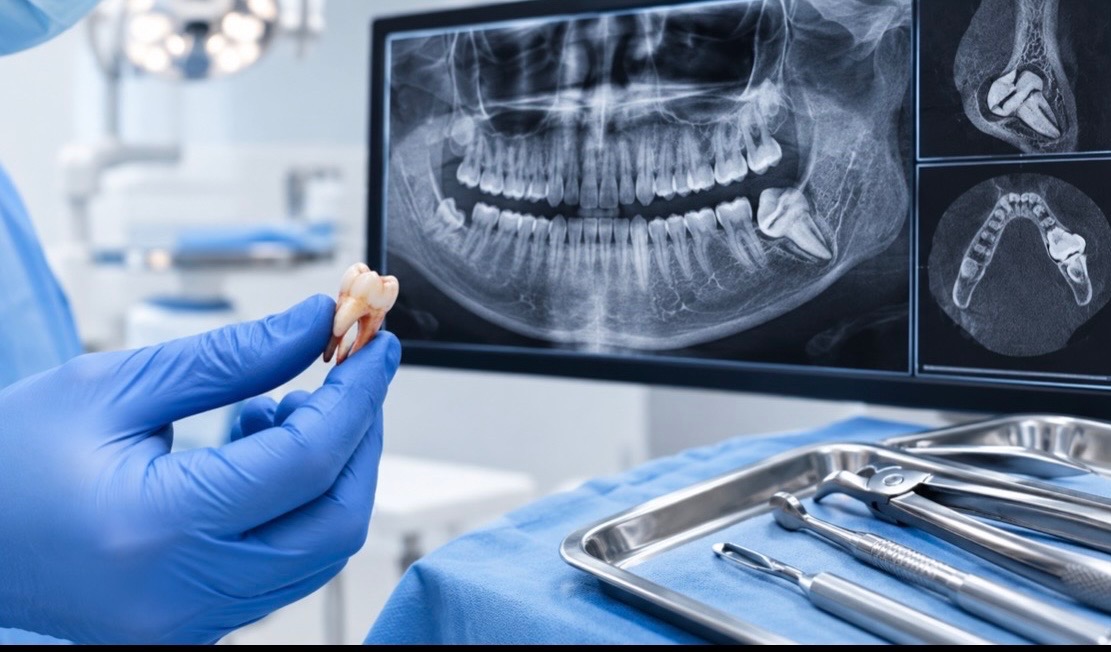
An X-ray can help your dentist or oral surgery clinician assess the shape and position of the roots. They can then decide on the most appropriate approach.
An impacted tooth is one that has not fully erupted into the mouth. Wisdom teeth are a common example.
An impacted tooth may be positioned underneath the gum or partially within the jawbone. Removing it can therefore require a surgical approach rather than a routine extraction.
Some teeth are positioned close to nerves, sinuses or other important anatomical structures.
Lower wisdom teeth can sometimes be located close to the inferior alveolar nerve, which provides sensation to the lower lip and chin. Careful assessment and treatment planning are particularly important in these situations.
Occasionally, an extraction that was expected to be straightforward can prove more difficult than anticipated.
If a tooth cannot be safely removed using routine techniques, your dentist may recommend an assessment with a clinician experienced in surgical extractions.
Your overall health, medications and previous dental treatment can sometimes affect how an extraction should be planned.
For patients with complex circumstances, having treatment with a clinician with experience in oral surgery can allow additional factors to be carefully considered.
The exact procedure will depend on the tooth being removed and your individual circumstances.
Before treatment, Dr Baljinder Kaur Narwal will assess the tooth and any relevant X-rays. She will explain the proposed procedure, discuss the potential risks and answer any questions you may have.
During the extraction, the area will be thoroughly numbed using local anaesthetic, so you should not feel pain during the procedure.
Depending on the tooth, treatment may involve making a small incision in the gum, removing a small amount of bone or dividing the tooth into sections before carefully removing it.
Although these techniques may sound daunting, they are commonly used when required to make a difficult extraction more controlled.
After the procedure, you will receive instructions to help you care for the area and support healing, along with information about what to expect during your recovery.
Not necessarily.
In many cases, it simply means that your dentist believes the extraction would benefit from additional surgical expertise because of the position or condition of the tooth, or because of your individual circumstances.
The aim is always to plan the safest and most appropriate approach for you.
We are delighted to have Dr Baljinder Kaur Narwal providing oral surgery at Knightsfield Dental Practice.
Her role allows us to offer patients access to additional expertise when a tooth extraction is considered complex or when a surgical approach may be required.
For patients who feel anxious about having a difficult tooth removed, knowing that their treatment is being carefully assessed and planned by a clinician with experience in oral surgery can also provide valuable reassurance.
At Knightsfield Dental Practice, we understand that the thought of having a tooth removed can be worrying — particularly if you’ve been told that your extraction may be more complicated than usual.
Our team takes the time to assess each case carefully and explain your treatment options, so you understand what is involved before proceeding.
If you have been told that you may need a complex tooth extraction, have an impacted wisdom tooth, or have a tooth that your dentist feels may be difficult to remove, Dr Baljinder Kaur Narwal can assess your individual situation and discuss the most appropriate treatment options with you.
Contact Knightsfield Dental Practice on 01707 329 634 to arrange an assessment and find out whether oral surgery may be appropriate for you https://booking.uk.hsone.app/soe/new/%20?pid=UKCYM01
BACK TO BLOG


I recently had some dental issues with broken teeth and saw Maya for a check-up. Maya gave me options to get my teeth repaired, and I now have 2 lovely new white fillings. I had also misplaced my denture, and Maya made me a new one, which fits so well and is so comfortable. The treatment from start to finish was explained in detail, and I’m really happy with the final results. I highly recommend this dental practice and am pleased to have found such a friendly, helpful team.

Today I had the ‘pleasure’ of a shiny new filling by Nishma, who has become a bit of a household name around here! The kids love her, and now, I have to pretend to be “Dentist Daddy” when brushing their teeth (inspired by Nishma)!
Zero pain.
100% friendliness.
On time.
In and out in 30 minutes.
As always, a lovely experience. Well, aside from the bill, I guess, but thanks to the UK Govt, we have to pay for dental treatment these days, and Nishma’s expertise comes at a fair and appropriate cost. Thanks, Nishma (and your lovely colleague) for a smooth experience (and smooth filling too)!
So grateful for the care and attention given at this practice every time I attend. Most recently to Maya, Ishira and Sarah for their patience, care in getting me seen and treated as quickly as possible. The phone call to check on me the next day is such a lovely touch; I have never had that at any other dental practice before. Highly recommend this practice!
Very professional team. Always on time. Very clean premises. Friendly staff. They seem up-to-date with new techniques and equipment. They take pride in their work. I have had several dentists at this practice over the years, but they are all very good at their job. Can recommend.
Recently changed my dentist to a local one and I have found all the staff here very friendly, caring and most importantly, understanding in terms of my ongoing oral health care. Treatment has been exceptional, easy and importantly pain pain-free and appropriate. Thank you, Anita, Maya and the team.
Excellent friendly practice, treatment was very good and painless, everything was explained, and great care was taken to ensure my comfort. Good ambience in the waiting room, the appointment was on time. Recommended.
Totally recommend this Dental Surgery! Maya and her team were very professional and kind. I cannot express how grateful I am to have new crowns and a bridge so that I can smile with confidence. They talked me through every stage, and the final result was brilliant.
Always delighted with the results of any treatment I receive. Face may crumble with age, but my smile shows the benefit of long years of care from Knightsfield Dental Practice.
Since Anita has been taking care of my teeth, I have been highly satisfied with Knightsfield Dental Practice. She is always bright, positive, caring and very clear about treatment options, which she executes professionally and well. Love my visits now.
I had an old filing replaced. The procedure was delivered very well, and in a nice, calm atmosphere. The anaesthetic took quite a long time to ease off – more like 4 hours before I could feel my bottom lip and cheek, but I’d rather that than feel the procedure (which I didn’t).
Highly recommend the service at the dentist. Thoroughly professional in the explanation and treatment of my teeth. A great experience, thank you!
I had an old filling that had to be replaced, and I had the treatment today. I can honestly say it was the most relaxing treatment; I didn’t feel a thing, and the dentist and her dental nurse were brilliant.
My treatment was concisely explained from start to finish, including aftercare. I was reminded of each appointment both by phone and email. The professionalism and diligence of Maya, Sarah and all staff were faultless.
I had to go to this practice as an emergency, being a very nervous patient, I can not tell you how nice they were. The dentist informed me of what treatment should be done, and the dental nurse was lovely and held my hand throughout the tooth extraction; they even gave me a coping strategy to use. Cannot recommend them enough, all staff were lovely and friendly.
I recently had some dental issues with broken teeth and saw Maya for a check-up. Maya gave me options to get my teeth repaired, and I now have 2 lovely new white fillings. I had also misplaced my denture, and Maya made me a new one, which fits so well and is so comfortable. The treatment from start to finish was explained in detail, and I’m really happy with the final results. I highly recommend this dental practice and am pleased to have found such a friendly, helpful team.
Today I had the ‘pleasure’ of a shiny new filling by Nishma, who has become a bit of a household name around here! The kids love her, and now, I have to pretend to be “Dentist Daddy” when brushing their teeth (inspired by Nishma)!
Zero pain.
100% friendliness.
On time.
In and out in 30 minutes.
As always, a lovely experience. Well, aside from the bill, I guess, but thanks to the UK Govt, we have to pay for dental treatment these days, and Nishma’s expertise comes at a fair and appropriate cost. Thanks, Nishma (and your lovely colleague) for a smooth experience (and smooth filling too)!
So grateful for the care and attention given at this practice every time I attend. Most recently to Maya, Ishira and Sarah for their patience, care in getting me seen and treated as quickly as possible. The phone call to check on me the next day is such a lovely touch; I have never had that at any other dental practice before. Highly recommend this practice!
Very professional team. Always on time. Very clean premises. Friendly staff. They seem up-to-date with new techniques and equipment. They take pride in their work. I have had several dentists at this practice over the years, but they are all very good at their job. Can recommend.
Recently changed my dentist to a local one and I have found all the staff here very friendly, caring and most importantly, understanding in terms of my ongoing oral health care. Treatment has been exceptional, easy and importantly pain pain-free and appropriate. Thank you, Anita, Maya and the team.
Excellent friendly practice, treatment was very good and painless, everything was explained, and great care was taken to ensure my comfort. Good ambience in the waiting room, the appointment was on time. Recommended.
Totally recommend this Dental Surgery! Maya and her team were very professional and kind. I cannot express how grateful I am to have new crowns and a bridge so that I can smile with confidence. They talked me through every stage, and the final result was brilliant.
Always delighted with the results of any treatment I receive. Face may crumble with age, but my smile shows the benefit of long years of care from Knightsfield Dental Practice.
Since Anita has been taking care of my teeth, I have been highly satisfied with Knightsfield Dental Practice. She is always bright, positive, caring and very clear about treatment options, which she executes professionally and well. Love my visits now.
I had an old filing replaced. The procedure was delivered very well, and in a nice, calm atmosphere. The anaesthetic took quite a long time to ease off – more like 4 hours before I could feel my bottom lip and cheek, but I’d rather that than feel the procedure (which I didn’t).
Highly recommend the service at the dentist. Thoroughly professional in the explanation and treatment of my teeth. A great experience, thank you!
I had an old filling that had to be replaced, and I had the treatment today. I can honestly say it was the most relaxing treatment; I didn’t feel a thing, and the dentist and her dental nurse were brilliant.
My treatment was concisely explained from start to finish, including aftercare. I was reminded of each appointment both by phone and email. The professionalism and diligence of Maya, Sarah and all staff were faultless.
I had to go to this practice as an emergency, being a very nervous patient, I can not tell you how nice they were. The dentist informed me of what treatment should be done, and the dental nurse was lovely and held my hand throughout the tooth extraction; they even gave me a coping strategy to use. Cannot recommend them enough, all staff were lovely and friendly.
Book a consultation today and let our friendly team guide you towards a healthier, more confident smile with personalised advice, modern treatments, and genuine care every step of the way.
BOOK YOUR CONSULTATION






 Instagram

 Facebook